White Background Paper for Product Photography (2026)

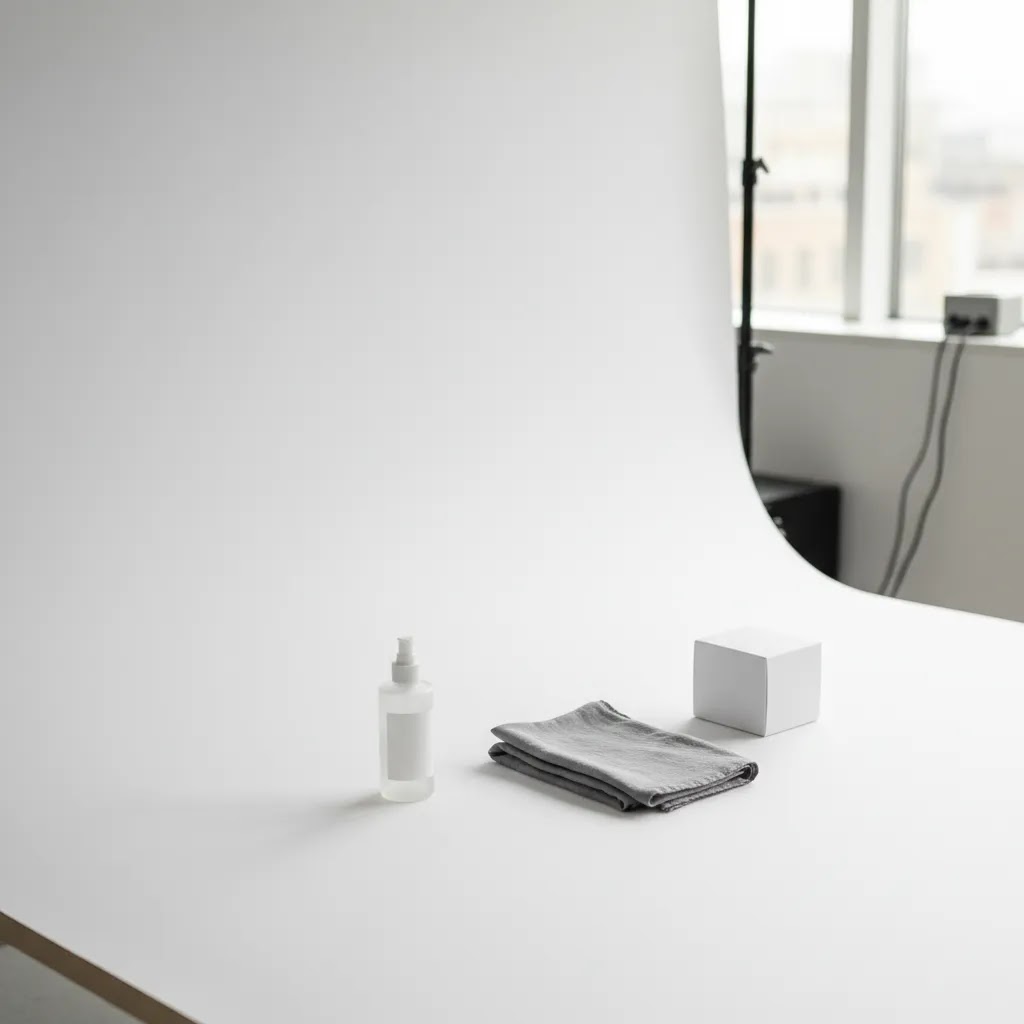
If you sell online, your product photos need to look clean, consistent, and trustworthy. For many Shopify merchants, that starts with a simple setup: white background paper. It is one of the most practical ways to create product images that work on product pages, marketplaces, ads, and email campaigns without adding visual clutter. The challenge is choosing the right type of paper, width, finish, and setup for your product size and workflow. A paper roll that works well for jewelry may be frustrating for apparel accessories or boxed products. If you are still weighing paper against fabric, vinyl, or other options, our guide to white backdrop for photos gives useful context before you buy. This article focuses on what white background paper does well, where it falls short, and how to decide if it is the right fit for your store.
Contents
- What white background paper is and why store owners use it
- What paper backdrops are called (and the common types you will see)
- Key features to evaluate before you buy
- Sizes, widths, and lengths: choosing a roll that fits your products and space
- Pros and Cons
- Who white background paper is best for
- AcquireConvert recommendation
- How to choose the right white background paper
- Practical setup and handling: mounting, storage, and keeping paper clean
- Frequently Asked Questions
- Key Takeaways
What white background paper is and why store owners use it
White background paper is a roll or sheet of matte white paper used as a clean photography surface behind and beneath a product. In ecommerce, it is popular because it helps create uniform product images without the folds, texture, and light reflections you often get from fabric or glossy surfaces.
For store owners, the real advantage is consistency. When your catalog images share the same clean white background, product grids look more professional and customers can focus on shape, color, and details instead of distractions in the scene. That can be especially helpful for stores with large SKUs, repeat launches, or frequent merchandising updates.
White paper backgrounds are also practical for smaller in-house studios. You can mount a roll, sweep it onto a table, and create a seamless curve that removes the line between vertical backdrop and flat surface. That is useful for product shots intended for Shopify collection pages, Google Shopping assets, and marketplace listings where a simple presentation often performs better than a busy setup.
That said, white background paper is not perfect for every workflow. It marks easily, needs replacement over time, and may not suit heavy products or shoots involving liquids, crumbs, or frequent prop changes. For products that need correction after the shoot, editing choices also matter. If you plan to refine edges or clean up shadows later, our article on photoshop white background product photography can help you understand where capture ends and post-production begins.
What paper backdrops are called (and the common types you will see)
If you have been shopping for white background paper, you have probably noticed it is sold under a few different names. The terms can feel confusing, but they usually point to the same core product, a roll of matte paper intended to create a clean background for photos.
Here are the most common terms you will see:
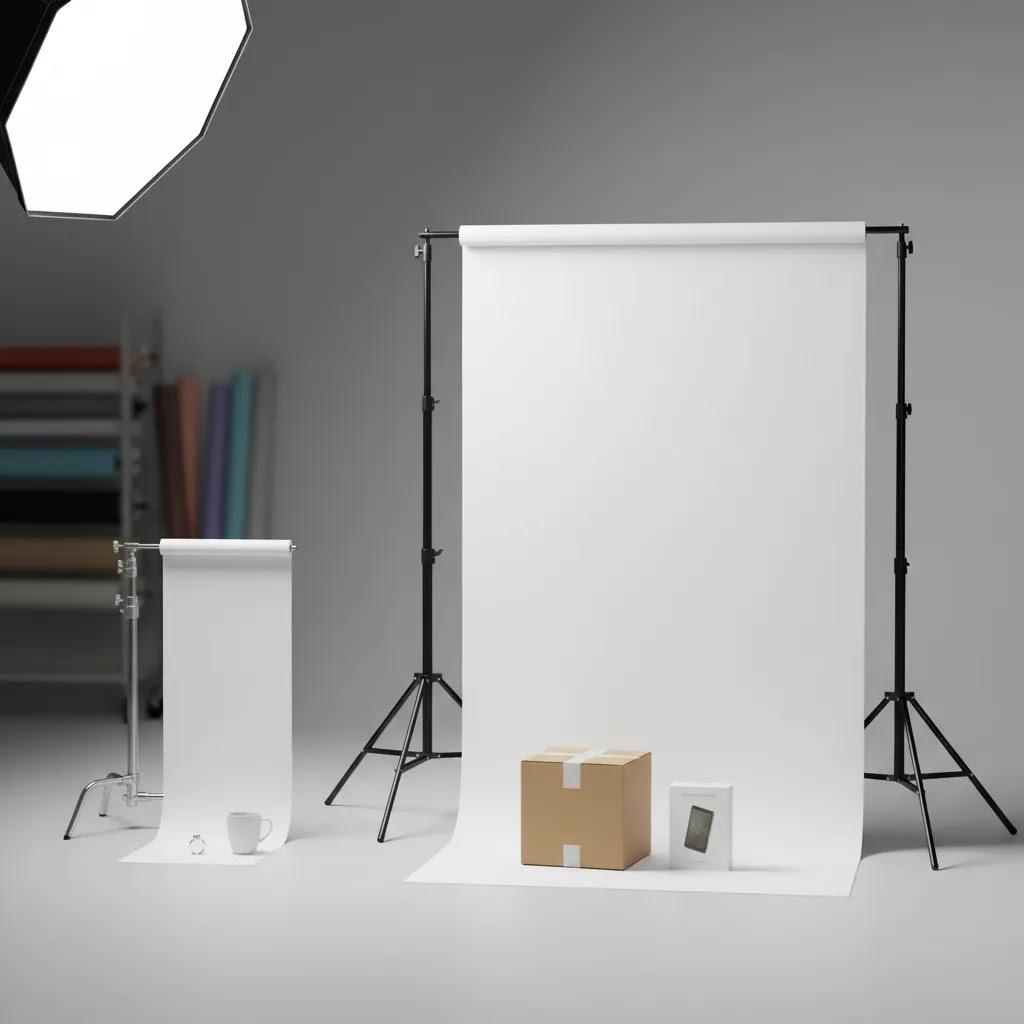
- Seamless paper or seamless backdrop: This is the most common industry term. “Seamless” refers to the way the paper is used, pulled down from the roll and curved onto the floor or table so you do not see a hard corner line.
- Paper sweep: This describes the setup, not a different product. A “sweep” is the curved section that transitions from vertical to horizontal.
- Background paper or photography background paper: This is the plain-language ecommerce term you will see in product listings, especially when sellers offer multiple colors or finishes.
Now, when it comes to format, you will typically see rolls and sheets. From a practical standpoint, rolls tend to be the default for ecommerce because they make it much easier to create a true seamless sweep. With sheets, you are usually dealing with a visible join, a hard crease, or a taped seam somewhere in your frame. Sheets can work for very small products or flat lays, but they are less forgiving if you need clean edges across hundreds of SKUs.
One more detail that matters for catalog consistency is how the paper is made. Many photography rolls are described as “non-reflective dyed paper” or “dyed through.” In practice, that usually means the paper is matte (so it does not throw bright glare back at your lights) and the color is consistent across the thickness of the paper, not just a surface coating. For product photography, that can reduce weird shiny patches and help keep your whites looking consistent session to session, which matters when you are building a uniform Shopify product grid.

Key features to evaluate before you buy
Not all white background paper performs the same way. Before you buy, focus on the features that directly affect your product photography workflow.
1. Width
The width of the roll determines the largest product scene you can shoot without cropping too tightly. Small tabletop items can work on narrower paper, but footwear, handbags, kitchen sets, and grouped products usually need more room. Buying too narrow often leads to awkward framing and extra editing.
2. Surface finish
A matte finish is generally the safer choice for ecommerce. It reduces glare and helps you keep whites clean without bright hotspots. That matters if you shoot reflective packaging, glass, cosmetics, or metal items where light control is already difficult.
3. Thickness and durability
Thin paper is lighter and often less expensive, but it tears and creases more easily. Thicker paper tends to sit more smoothly and hold up better during repeat shoots. If your team updates product photos weekly, durability has a direct effect on both setup time and replacement cost.
4. Color consistency
You want a true white or near-neutral white, not a warm cream or cool blue cast. A noticeable tint can create more editing work across your catalog. This becomes more important when your store relies on uniform image blocks or when multiple team members shoot products on different days.
5. Replaceability in your workflow
One underrated factor is how quickly you can cut, roll forward, and reset a fresh section. Paper works best when your process is simple. If you are constantly retaping edges or smoothing damage, it stops being efficient. For stores building a repeatable in-house setup, this often matters more than the paper itself. That is why planning your wider product photography studio setup is just as important as choosing the background material.
If you sell food, surfaces also need to handle frequent mess and quick resets. In that case, white paper can still work, but you need to be realistic about waste and replacements. Our guide to food photography white background covers those practical trade-offs in more detail.
Sizes, widths, and lengths: choosing a roll that fits your products and space
Most store owners focus on “white” and “matte,” then get surprised by how much the physical size of the roll affects day-to-day shooting. Width is the headline spec, but length and your available space determine whether the setup feels smooth or constantly cramped.
Common roll widths and what they typically fit
Exact sizes vary by seller, but you will usually see rolls offered in a few common width ranges. Think of it this way, you are buying shooting flexibility.
- Narrow rolls: Often best for small products like jewelry, skincare bottles, supplements, phone cases, and other compact Shopify items where you shoot tight and consistent.
- Medium-width rolls: A good fit for footwear, handbags, hats, boxed goods, and most “tabletop” product categories. This is also where bundles start to feel less cramped.
- Wide rolls: Useful when you shoot larger groupings, wider props, or larger packaging, and when you want more negative space for cropping across different placements. If you plan to shoot anything close to full-body or large items, wide paper becomes more relevant, but your room layout becomes the limiting factor fast.
What many store owners overlook is that tight spaces change the recommendation. In a small home studio, a roll that is technically “wide enough” can still be hard to use if you cannot back your camera up far enough to frame the product without distortion. In many cases, a medium width roll with a clean, repeatable framing plan beats a huge roll that you cannot physically shoot properly in your space.
A quick way to measure your scene before you buy
You do not need to overthink this, but you do need a plan. Start by measuring four things: the width of your table (or the surface you will shoot on), the height of your tallest typical product, how far back you can place your camera, and how much extra background you want around the product for cropping.
From a practical standpoint, the “extra background” piece matters more than people expect. You will often want breathing room around the product so you can crop variants for different placements, keep a consistent aspect ratio across Shopify product grids, and meet marketplace image requirements without having to rebuild white space later in editing.
Length matters because paper is a consumable
Roll length determines how long you can keep shooting before you hit the core reality of paper, you will be cutting and advancing it. The replacement rate is not only driven by “mess.” Shoe soles and rubber feet can scuff quickly. Stands and clamps can dent the surface. Tape can tear paper when you reset. If you do frequent shoot days, or you constantly reposition products, you typically burn through paper faster than you expect even in a clean studio.
A useful mindset is to assume you will replace paper in sections. You roll forward to a fresh area, then cut off the damaged part when it becomes noticeable. That workflow is normal, and it is one of the reasons rolls tend to beat sheets for ecommerce teams that need a repeatable process.
Pros and Cons
Strengths
- Creates a clean, minimal look that suits many ecommerce product pages and marketplaces.
- Helps maintain visual consistency across large catalogs, especially for Shopify collection pages.
- Works well as a seamless sweep, reducing the visible horizon line behind products.
- Usually produces fewer wrinkles and texture distractions than fabric backdrops.
- Matte white paper can make lighting easier to manage than glossy boards or reflective surfaces.
- Simple for small teams to set up in-house without a complex studio build.
Considerations
- Marks, scuffs, and tears easily, so replacement is part of the ongoing cost.
- Less suitable for heavy products, wet products, or messy scenes that damage the surface quickly.
- Requires storage space and careful handling to avoid bent edges or dirty sections.
- Can still require editing if the white background is unevenly lit or not clipped cleanly.
Who white background paper is best for
White background paper is a strong fit for ecommerce brands that need repeatable, standardized product imagery. If you run a Shopify store with a growing SKU count and want product pages to look consistent without hiring a photographer for every update, it is often a sensible starting point.
It is especially useful for small to mid-sized products such as cosmetics, supplements, tech accessories, stationery, home goods, and packaged items. It also suits merchants creating marketplace-friendly images where neutral presentation matters.
It may be a weaker fit if you sell oversized items, shoot frequent lifestyle scenes, or need highly durable surfaces for heavy production use. In those cases, paper can still be part of your setup, but not always the only background you rely on.
AcquireConvert recommendation
If you are choosing white background paper for an ecommerce workflow, think beyond the material itself. The best choice is the one that fits your products, lighting setup, editing process, and content volume. That practical approach is how AcquireConvert covers product photography decisions for online stores.
AcquireConvert is led by Giles Thomas, a Shopify Partner and Google Expert, so the advice is grounded in how product images actually support merchandising, paid traffic, and conversion paths. Rather than treating photography as a standalone creative decision, the focus stays on how visuals help store owners sell more clearly and consistently.
For deeper guidance, explore the broader White Background Photography section and the foundational Product Photography Fundamentals resources. If your next decision is whether to improve images in the studio or fix them in post, the related AcquireConvert guides linked throughout this article are a practical next step.
How to choose the right white background paper
Here is a straightforward way to evaluate white background paper like a store owner, not just a photographer.
Match the paper width to your largest routine shoot
Do not buy based on your smallest product. Buy for the largest product or grouped setup you expect to shoot regularly. If your paper is too narrow, you will spend more time cropping tightly, masking edges, or rebuilding white space in editing.
Choose matte over glossy for most ecommerce use cases
Most stores benefit from matte paper because it is easier to light and usually creates fewer reflections. This is particularly true for skincare, packaged goods, electronics, glass, and metallic products. If your photos are destined for product pages where customers zoom in, surface reflections can quickly make images feel inconsistent.
Estimate your replacement rate honestly
Paper is consumable. That is not a flaw, but you need to account for it. If you shoot a few products each month, replacement may be minimal. If you photograph inventory weekly, test new props often, or have multiple team members using the same setup, paper wear will be much faster. Build that into your operating cost.
Think about editing time, not just shooting time
A lower-cost paper option is not necessarily the best value if it adds cleanup work. If the paper creases easily, picks up dust, or shows shadows unevenly, your team may spend more time in editing software than you save on materials. In ecommerce, speed and consistency often matter more than marginal savings on supplies.
Consider where your images will be used
If your product photos are primarily for clean catalog pages, ads, and comparison shopping placements, white background paper is often a good fit. If you also need social content, landing page hero shots, and brand storytelling assets, paper should probably be one part of a mixed setup that also includes styled and lifestyle scenes.
A practical system many merchants use is this: capture clean core product images on paper, then build richer creative assets separately. That keeps your catalog efficient while giving your marketing team room to create more expressive content when needed.
Practical setup and handling: mounting, storage, and keeping paper clean
Buying the right roll is only half the job. The reality is that most “paper problems” in ecommerce come from setup and handling, not the paper itself. A few simple choices can reduce waste and make the whole workflow feel more repeatable.
Mounting options that work for small in-house setups
For most Shopify store owners shooting in-house, you have three realistic mounting approaches.
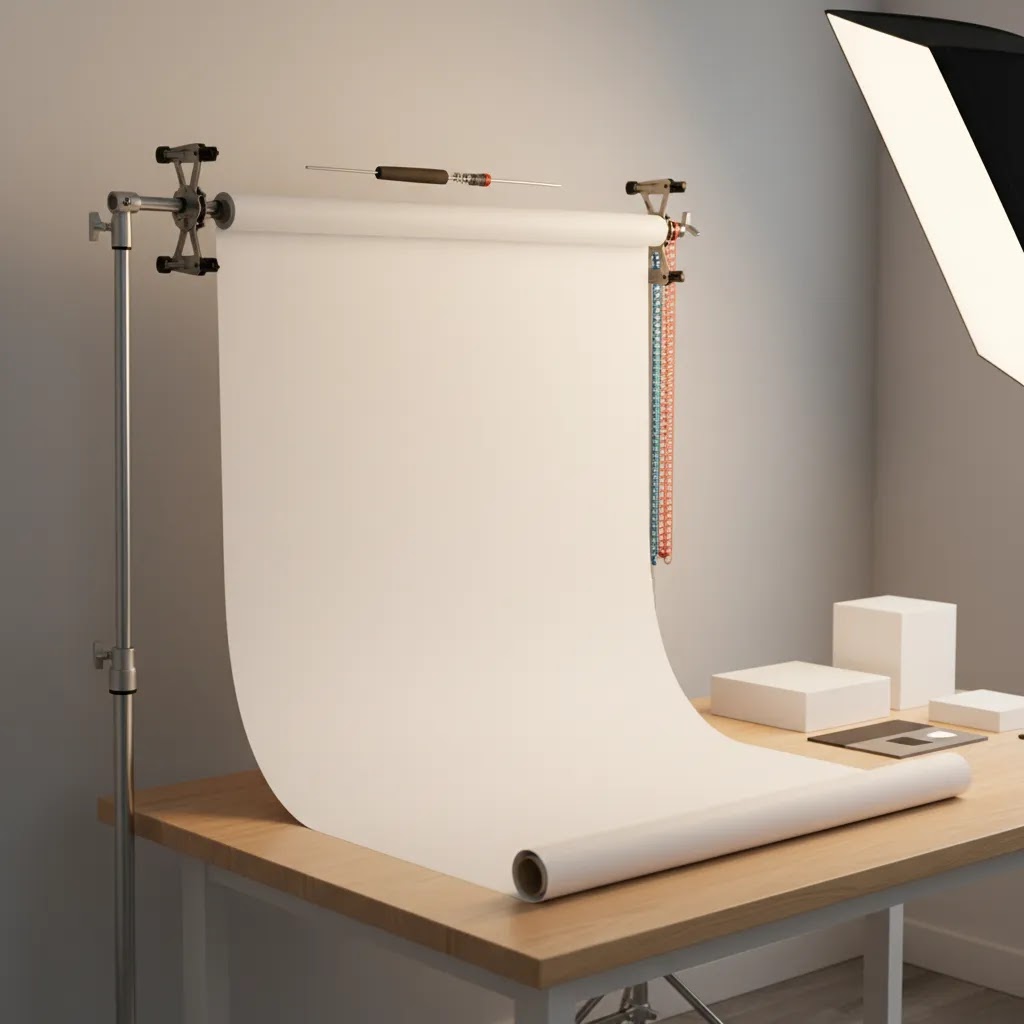
- Backdrop stand with a crossbar: This is common because it is flexible. You can set it up in a spare room, adjust the height, and pack it away. It is also easier if you want to swap between white and other background colors.
- Wall or ceiling mount: This is the most stable option if you have a dedicated corner for photography. It saves floor space and makes it faster to start a shoot, which matters when product photography competes with the rest of your weekly ops.
- Clamping to a table: For small tabletop products, you can clamp the roll behind the table and pull it forward into a sweep. It is not as durable as a proper mount, but it can work if you are testing the workflow or you only shoot occasionally.
Whatever you use, the goal is the same: keep tension consistent so the paper does not sag, wrinkle, or develop a “wavy” sweep that makes lighting harder.
Handling habits that reduce waste
Paper gets dirty fast when the “shooting zone” and the “walking zone” become the same place. Consider this, you can keep the visible area clean without replacing the whole sweep every time if you run a tighter process.
- Create a defined product zone on the paper and keep hands, feet, and stands out of it whenever possible.
- Roll forward a small amount when marks appear, rather than trying to scrub paper clean. Scrubbing often makes the surface look worse on camera.
- Cut cleanly when you remove damaged sections so the new edge sits flat and does not tear further.
- Minimize floor contact for tabletop shoots. If your paper reaches the floor, it will pick up dust and shoe marks quickly, even in a clean room.
- Manage curl at the front edge by using gentle weight or a clean clamp outside the frame. Curl can create shadows that are annoying to fix later.
Think of it this way, you are not trying to make paper “last forever.” You are trying to make replacements predictable and fast, so the setup stays reliable.
Storage and longevity realities
Paper rolls hate being knocked around. If you lean a roll in a corner without protecting the edges, you can end up with dents and flat spots that show up as uneven highlights in your photos.
Store rolls horizontally when you can, keep the ends protected, and avoid placing heavy gear on top of them. Also, try not to leave paper exposed in high traffic areas where it can collect dust or get scuffed before you even start shooting. Most teams end up replacing paper in sections, not because the roll is “used up,” but because the active shooting area takes damage over time.
Frequently Asked Questions
Is white background paper better than fabric for product photography?
It depends on your workflow. White background paper usually gives a smoother, cleaner look with fewer wrinkles than fabric, which makes it attractive for ecommerce catalog images. Fabric can be more reusable, but it often needs more steaming, clipping, or editing. For many store owners shooting standard product photos, paper is the more consistent option.
What size white background paper should I buy?
Choose a width based on the largest product or grouped setup you photograph regularly, not your smallest item. If you sell small boxed goods, a narrower roll may be enough. If you shoot handbags, shoes, bundles, or flat lays, a wider roll gives you more flexibility and reduces the need for tight crops.
Does white background paper work for Shopify product photos?
Yes, it can work very well for Shopify product photos because it helps create a uniform look across collection pages and product grids. Clean backgrounds also keep attention on the product itself. What matters most is consistent lighting, color accuracy, and framing, not the paper alone.
How do I keep a white paper background looking clean?
Handle products carefully, keep shoes and dirty props off the shooting area, and roll forward a fresh section when marks appear. Many teams also use gloves for reflective or premium items. Since paper is easily damaged, planning for regular replacement is part of using it effectively.
Can I use white printer paper as a photography background?
You can for very small items or quick tests, but it is rarely ideal for serious ecommerce photography. Printer paper is typically too small, curls easily, and shows seams when joined. A dedicated photography paper roll is usually a better fit if you need repeatable product images for your online store.
Do I still need editing if I shoot on white background paper?
Usually, yes. White paper can reduce background distractions, but you may still need to clean dust, refine shadows, correct exposure, or standardize whites across a product range. Good capture reduces editing time, but it does not always remove the need for post-production entirely.
Is white background paper good for food photography?
It can be, especially for clean, minimal food shots, but it is less forgiving in messy environments. Spills, oils, crumbs, and sauces can damage paper quickly. If you shoot food often, expect more replacement and consider whether your setup needs a more durable surface for repeated sessions.
What is the main drawback of white background paper?
The biggest drawback is durability. It is great for a clean look, but it scuffs, tears, and gets dirty faster than some alternatives. For low-volume catalog work that may be acceptable. For frequent, high-volume shoots, the replacement cycle can become a meaningful operational factor.
What type of paper is used for backdrops?
Most photography paper backdrops are matte, non-reflective paper designed to be pulled into a seamless sweep. You will often see it described as seamless paper, background paper, or a paper backdrop roll. For ecommerce, matte paper is typically preferred because it is easier to light evenly and produces fewer glare issues on packaging and reflective products.
What is a background paper?
Background paper is a paper surface used behind (and often under) a product to create a clean, controlled backdrop in photos. In product photography, it is commonly used as a seamless sweep so there is no visible corner line, which helps create the clean catalog look many Shopify stores want.
What can I use as a white backdrop?
You can use white background paper, white foam board, a white wall, or a white fabric backdrop depending on your space and how consistent you need results to be. Paper is popular for ecommerce because it is smooth and predictable, but it is also consumable. Foam board and walls can be more durable, while fabric is more reusable but often adds wrinkles and texture that you may need to manage.
What are paper backdrops called?
Paper backdrops are often called seamless paper, seamless backdrops, paper sweeps, or photography background paper. The names vary by seller, but they usually refer to the same idea, a roll of matte paper used to create a smooth background behind products.
Key Takeaways
- White background paper is often a strong choice for clean, consistent ecommerce product photos.
- Matte paper usually works best because it reduces glare and is easier to light evenly.
- Buy for your largest regular product setup, not your smallest item.
- Factor in replacement and editing time, not just the initial material cost.
- Use white paper for core catalog images, then build separate creative assets for lifestyle and campaign content.
Conclusion
White background paper remains one of the most practical tools for ecommerce product photography because it helps you create clean, consistent images without an overly complex setup. For many Shopify store owners, that makes it a reliable choice for catalog photos, collection pages, and ad creatives where clarity matters most. Still, the right decision depends on your product size, shoot frequency, mess level, and editing workflow. Paper is efficient, but it is also disposable, so the best option is the one that fits how your team actually works. If you want more help deciding between background types, editing methods, and studio setups, explore AcquireConvert’s related photography resources. Giles Thomas’s Shopify and ecommerce expertise keeps the advice grounded in what real store owners can implement.
This article is editorial content created for educational purposes and is not a paid endorsement unless explicitly stated otherwise. Pricing, product specifications, and availability are subject to change. Always verify current details directly with the provider or seller before purchasing. Any performance or conversion outcomes from photography improvements will vary by store, product, traffic quality, and execution, and are not guaranteed.

Hi, I'm Giles Thomas.
Founder of AcquireConvert, the place where ecommerce entrepreneurs & marketers go to learn growth. I'm also the founder of Shopify agency Whole Design Studios.