Best Lens for Product Photography (2026 Guide)

If you sell online, the best lens for product photography is not necessarily the most expensive one. It is the lens that matches your products, shooting space, and the type of detail your customers need to see before they buy. A jewelry brand, a skincare store, and a homeware shop will all need different focal lengths and working distances. That is why lens choice has a direct effect on image sharpness, distortion, consistency, and ultimately how trustworthy your product pages feel. This guide is built for ecommerce operators who want a practical answer, not camera-forum theory. If you are also planning a broader visual style upgrade, it helps to understand how lifestyle photography fits alongside clean catalog shots and conversion-focused product imagery.
Contents
- What lens is best for product photography?
- Best focal lengths by product type and shot style
- What matters more than brand name
- Lens selection by camera brand and mount (Canon, Sony, Nikon, Fujifilm)
- Pros and Cons
- Common product photography lens rules (and what actually matters for ecommerce)
- Who this guide is for
- AcquireConvert recommendation
- How to choose the right lens
- Frequently Asked Questions
- Key Takeaways
- Conclusion
What lens is best for product photography?
For most product photography, a 90mm to 105mm macro lens is the safest all-around choice if you use a full-frame camera. On APS-C cameras, something closer to 60mm to 70mm macro often gives a similar field of view. That range works well because it gives you strong detail, minimal distortion, and enough distance between your camera and product.
If you only photograph medium or large products such as shoes, bags, packaged goods, or home accessories, a 50mm lens can also work well, especially in smaller home studios. If you mainly shoot tiny items such as watches, rings, cosmetics textures, or product labels, a true macro lens is usually the better option.
For ecommerce, the goal is consistency first. You want product images that look accurate across collections, variants, and PDP galleries. That often matters more than creative blur or dramatic perspective. If you also create scene-based content, pairing the right lens with an ai scene generator can help you build supporting lifestyle visuals without reshooting every angle from scratch.
The short version is this:
- Choose 90mm to 105mm macro for close-up precision and premium detail
- Choose 50mm for larger products and tighter spaces
- Choose 24mm to 35mm only for wider lifestyle scenes, not primary packshots
- Avoid very wide lenses for core product images because they can stretch shape and proportions
Best focal lengths by product type and shot style
Here is the thing, most Shopify stores are not shooting one type of image. You usually need a mix: clean PDP hero shots, detail close-ups, occasional flat lays, and a few lifestyle frames for ads or collection pages. The focal length you pick should match the shot you need, and the space you are shooting in.
From a practical standpoint, these focal lengths tend to map well to common ecommerce shots:
- Macro detail shots (textures, stitching, labels, watch dials): 90mm to 105mm macro on full frame, or 60mm to 70mm macro on APS-C. If you are shooting tiny items all day, that extra working distance can make lighting and reflections much easier to control.
- Standard PDP hero images (most products, minimal distortion): 50mm to 85mm on full frame, or roughly 35mm to 56mm on APS-C. This is the range that usually keeps proportions looking honest while still being workable in a home studio.
- Flat lays and overhead grids (apparel flats, kits, bundles): 35mm to 50mm on full frame, or 23mm to 35mm on APS-C. Flat lays are often about fitting the whole arrangement without standing on a ladder, so slightly wider can be practical, as long as you keep the camera perfectly level to avoid edge stretching.
- Lifestyle scenes (room context, hands in frame, model shots): 24mm to 35mm on full frame, or 16mm to 23mm on APS-C. This is where wide lenses make sense, because you are selling a story and environment, not exact packshot proportions.
Now, when it comes to working distance, a quick sanity check helps you avoid buying a lens that is technically great but impossible in your space. A 100mm macro often needs you to stand farther back for a full product shot than many merchants expect. In a small room, that can be a dealbreaker for anything larger than a small box or bottle. In many cases, a shorter macro (around 60mm on APS-C, or 60mm on full frame if your system offers it) is the more workable choice because you can frame a larger subject without backing into a wall.
What many store owners overlook is perspective distortion. If you go wider just to fit more in the frame, you usually pay for it with stretched corners and products that look subtly misshapen. For packshots and PDP hero images, it is typically better to step back and use a normal or short telephoto focal length, even if that means you need to rearrange your shooting table or give yourself more room behind the camera.
What matters more than brand name
Store owners often ask whether Canon, Sony, Nikon, or Fujifilm makes the best lens for product photography. In practice, the mount matters less than the shooting characteristics. There are five things to evaluate before you buy.
1. True macro capability
If you need texture shots, material detail, packaging text, or beauty close-ups, look for a lens with 1:1 macro reproduction. This is especially useful for skincare, watches, jewelry, and makeup. If your niche depends on detail confidence, your lens needs to resolve that detail cleanly.
2. Low distortion
Products should look proportionally correct. Wide-angle lenses can make bottles bulge, boxes taper, or edges bend. That creates extra retouching work and can make product pages feel less trustworthy. A normal or short telephoto lens usually gives cleaner lines.
3. Comfortable working distance
Working distance is easy to overlook until you are shooting all day. A longer macro lens gives you more room for lighting, reflectors, hands, and styling tools. That is one reason many experienced operators prefer 90mm to 105mm for small items.
4. Sharpness at practical apertures
Many product photographers shoot around f/8 to f/13 to hold enough detail across the item. You do not need a lens that only performs wide open for portraits. You need one that stays crisp where product shooters actually work.
5. Compatibility with your broader content workflow
If your store needs both white-background product images and richer social or landing-page visuals, your lens should support both. You may still want a second lens later for brand storytelling or motion content. For example, if you plan to expand into richer media, reviewing product videography services can help you decide whether stills alone are enough for your current stage.
Your lens choice also needs to match the rest of your setup. The best lens cannot fix poor light, weak support, or inconsistent staging. That is why merchants should think in systems, not isolated gear purchases. If you are still refining your space, a dedicated product photography studio setup can improve consistency more than a lens upgrade on its own.
Lens selection by camera brand and mount (Canon, Sony, Nikon, Fujifilm)
If you already own a camera, your real choice is usually inside your system. You want a lens that fits your mount, matches your sensor size, and gives you the working distance you actually have in your room.
First, a plain-English note on “equivalent focal length.” If you have an APS-C camera, the sensor is smaller than full frame. That means a 60mm lens on APS-C gives a similar field of view to roughly a 90mm lens on full frame. You are not getting extra zoom, you are just seeing a tighter crop. For product photography, this is helpful because it explains why APS-C users often land on 60mm macro instead of 100mm macro.
Within the main ecosystems, the simplest way to think about it is:
- Canon: for full frame bodies, look for a macro around 100mm. For APS-C bodies, a macro around 60mm is often the more practical everyday choice.
- Sony: the same logic applies, full frame commonly pairs well with a 90mm macro range, and APS-C often pairs well with a 50mm to 70mm macro range depending on your space and product size.
- Nikon: for full frame, the 105mm macro range is a common workhorse focal length for detail-heavy ecommerce. For APS-C, something closer to 60mm macro can be easier to use in tight studios.
- Fujifilm (APS-C): many merchants do well with a macro in the 60mm to 80mm range, because that gets you into the “short telephoto” look that keeps proportions clean for packshots and close-ups.
Before you buy, use this checklist to avoid the expensive mistakes that show up in used listings and marketplace deals:
- Mount compatibility: make sure the lens is designed for your mount, not just the brand. In some cases, lenses with the same brand name still will not fit your body without an adapter.
- Sensor coverage: confirm whether the lens is made for full frame or APS-C. An APS-C lens can work on some full frame bodies, but it may crop your image or show heavy vignetting, depending on the camera.
- Minimum focusing distance and magnification: if you need real close-ups, check for 1:1 macro and a practical minimum focus distance that fits your lighting setup.
- Autofocus considerations: for product work, you may focus manually a lot, especially on a tripod. Autofocus still helps for handheld lifestyle frames, but it is not the main reason a lens succeeds for ecommerce.
- Image stabilization: if you shoot on a tripod with controlled lighting, stabilization matters less. If you shoot handheld lifestyle content, stabilization can be useful, but it still does not replace good light and steady technique.
If you are buying used, you can often get excellent value, but inspect the listing like an operator, not a collector. Look for clean front and rear elements, no haze or fungus, and a focus ring that feels smooth and consistent. Ask about decentering if the seller has test photos. For ecommerce, you want reliable sharpness across the frame and predictable performance, not a “rare” lens that creates extra problems in post.
Pros and Cons
Strengths
- A 90mm to 105mm macro lens gives highly detailed product images that work well for zoom-enabled product pages.
- Short telephoto and macro focal lengths usually reduce visual distortion, which helps products look accurate and premium.
- Macro lenses are versatile for many ecommerce categories, including beauty, accessories, watches, packaged goods, and handmade products.
- A 50mm lens can be a practical lower-cost starting point if you mainly shoot medium-sized products in a small room.
- The right lens can reduce editing time because edges, text, and proportions tend to capture more cleanly in-camera.
- Consistent focal length across your catalog helps create a more cohesive storefront and stronger brand presentation.
Considerations
- Macro lenses are often more expensive and heavier than standard kit lenses, so they may not be the first upgrade for every new store.
- Longer focal lengths need more shooting distance, which can be limiting in a small apartment or compact office studio.
- A great lens will not solve poor lighting, camera shake, or weak styling decisions.
- If you shoot both products and broad environmental scenes, one lens may not cover every content type equally well.
Common product photography lens rules (and what actually matters for ecommerce)
If you have searched for the best lens for product photography, you have probably run into rules from photography communities. Some are useful, some are context-specific, and some just distract you from what matters for Shopify product pages.
Think of it this way, ecommerce has two jobs. First, sell the product accurately on the PDP. Second, support acquisition with scroll-stopping lifestyle or ad creative. The lens “rules” start to make sense when you tie them to those two jobs.
35mm vs 50mm is really a packshot vs scene question
A 35mm lens is often popular for general photography because it captures more environment. For ecommerce, that can be great for lifestyle scenes, behind-the-scenes content, and room context. It is rarely the best choice for your core packshots because 35mm is more likely to introduce perspective distortion if you are close to the product.
A 50mm lens is usually a safer default for product catalogs because it looks more natural and keeps shapes more consistent. If you are choosing between them for a small home studio, 50mm is typically the better bet for PDP hero images, and 35mm is the better bet as a second lens for wider brand content.
The “holy trinity” matters less for stores than creators think
The “holy trinity” usually refers to three pro zooms that cover wide, normal, and telephoto ranges. It is a great concept for event shooters who need to adapt fast. For ecommerce product photography, it is often overkill. You are not chasing unpredictable moments, you are building repeatable, consistent images that match a catalog standard.
Many stores do better with one strong macro lens for the catalog, plus one wider option later for lifestyle. That approach often keeps your product pages more consistent than swapping zooms and distances every shoot.
When a 70-200 style zoom is useful for product photography
A 70-200mm lens is popular because it can create flattering compression and high perceived sharpness for portraits and events. For product work, it can be useful when you have space to step back, especially for larger items, furniture-like products, or shoots where you want very clean perspective and minimal distortion.
The reality is that for most Shopify catalogs, especially small to mid-sized products, a 70-200 is not a requirement. It is large, expensive, and can be awkward in tight rooms. If your primary need is product detail and consistent PDP framing, a macro lens typically delivers more of what you need for less complexity.
A decision shortcut if you only want one lens now
If you want one lens that covers the highest percentage of ecommerce needs, start with a macro lens in the recommended range for your sensor size. It gives you PDP hero shots, detail crops, and cleaner proportions for most products.
If you know you will add a second lens later, make that second lens match your content mix. Go wider if you plan to shoot lifestyle and campaign scenes in tight spaces. Go longer if you sell large products and have room to back up. In many cases, two well-chosen lenses beat a bag of “almost right” options.
Who this guide is for
This guide is for ecommerce store owners, Shopify merchants, and in-house content teams choosing gear for product page images, collection banners, marketplace listings, and paid social creative. It is especially useful if you are deciding between a standard lens and a macro lens and want to avoid buying twice.
If you sell detail-sensitive products such as cosmetics, watches, jewelry, supplements, or handmade items, lens choice has a bigger commercial impact because customers rely on texture and finish cues before buying. If you are building out broader branded imagery too, reviewing different lifestyle photoshoot ideas can help you separate the lens you need for packshots from the lens you may want later for campaign content.
AcquireConvert recommendation
If you are making this decision for a Shopify store, think about the lens in terms of conversion clarity, not just photography specs. Giles Thomas, the expert behind AcquireConvert, approaches ecommerce content from the practical side of what helps merchants present products more credibly and consistently. As a Shopify Partner and Google Expert, his perspective is especially useful if your product images need to perform not only on your storefront but also across search, shopping feeds, and paid acquisition creative.
For most stores, the strongest buying path looks like this: choose one primary focal length for consistent PDP images, build a repeatable lighting setup, then use selective AI and editing tools to speed up production without compromising accuracy. If you need image workflow support, AcquireConvert also covers areas like Product Photography Fundamentals and Product Photo Lighting so you can make the lens decision in context.
On the AI side, tools such as AI Background Generator, Free White Background Generator, Increase Image Resolution, and Background Swap Editor may help streamline image post-production. They are most useful after you have captured a clean, sharp base image with the right lens and lighting.
How to choose the right lens for your store
If you are still unsure what is the best lens for product photography in your situation, use these five decision criteria.
Match lens choice to product size
Small products usually benefit from a macro lens. Watches, makeup packaging, droppers, labels, and jewelry need close focus and edge-to-edge detail. Larger items such as apparel flats, footwear, gift boxes, and kitchenware may look great with a 50mm lens, especially if your room is tight.
Decide whether your priority is catalog accuracy or brand storytelling
If your main goal is clean white-background images for your store, Amazon, or Google Shopping, distortion control matters more than mood. A macro or normal lens is the better fit. If you are building social-first imagery, you may eventually want a second wider lens for environmental scenes. That is a separate need from your core ecommerce lens.
Consider your shooting space
A longer lens may be technically ideal but impractical if you cannot step back far enough. Before buying, mock up your setup with your current camera and measure the distance needed to frame your most common product size. Space constraints often decide between 60mm and 100mm more than image quality does.
Think about lighting and support together
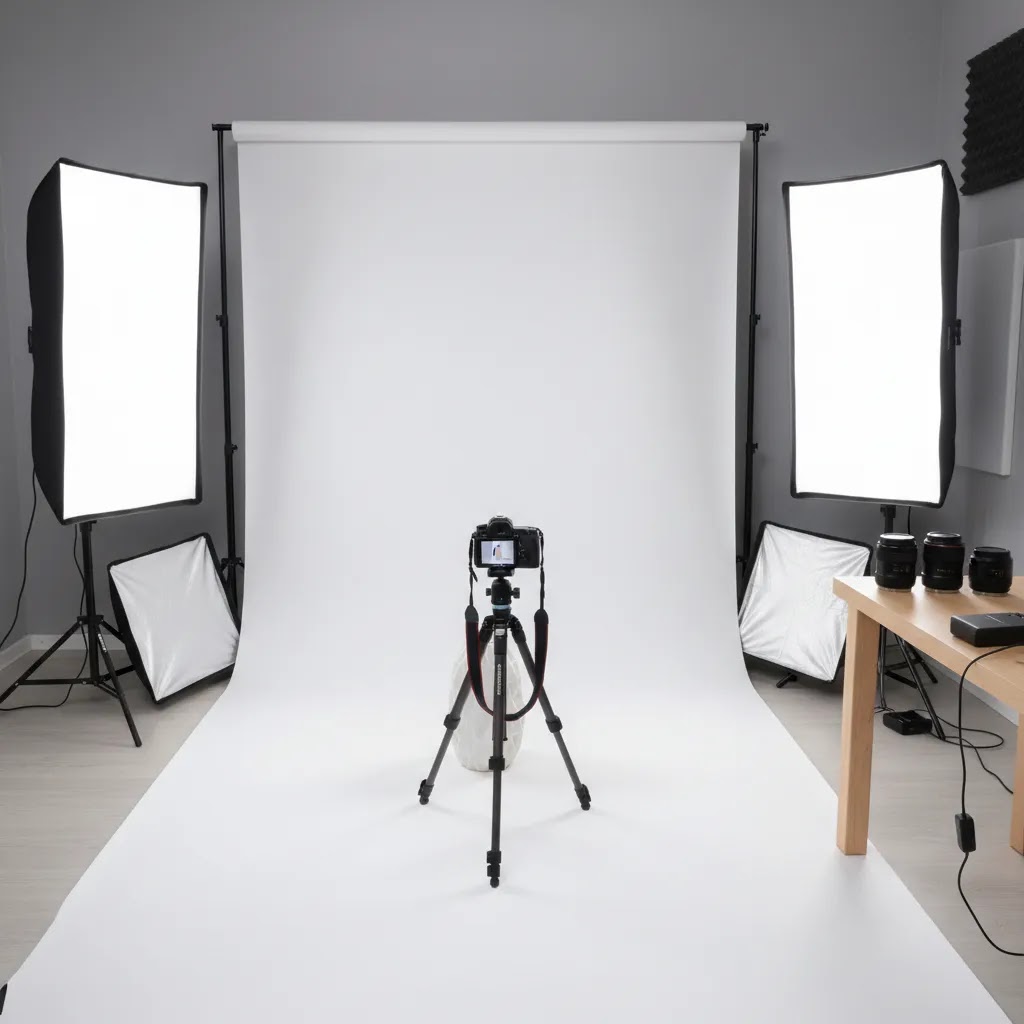
Merchants often search for the best lighting for product photography and the best lights for product photography at the same time as lenses, and that makes sense. Product images are a system. A tripod, controlled light, reflectors, and repeatable camera position usually have as much impact as lens quality. If your images are soft, the problem may be shutter speed, vibration, or poor light before it is glass quality.
Plan for post-production efficiency
The cleaner your base image, the faster your editing workflow. For example, if you need marketplace-ready white backgrounds, a crisp source photo will generally make tools like Magic Photo Editor or Creator Studio more effective. AI tools can help with background cleanup, scene variation, or upscaling, but they work best when the original shot is properly lit and in focus.
Practical default recommendation: if you can afford one dedicated lens for ecommerce product photography, buy a macro lens around 90mm to 105mm for full frame, or around 60mm to 70mm for APS-C. If your products are larger and your room is small, start with a 50mm lens and improve your lighting before upgrading further.
Frequently Asked Questions
What is the best lens for product photography overall?
For most ecommerce use cases, a 90mm to 105mm macro lens is the strongest all-around choice on a full-frame camera. It gives sharp detail, minimal distortion, and enough working distance for lighting and styling. If you use an APS-C camera, a 60mm to 70mm macro often delivers a similar practical result.
Is a 50mm lens good for product photography?
Yes, a 50mm lens can work very well for product photography, especially for medium-sized products and small home studios. It is often a sensible starting point if you sell shoes, boxes, candles, or packaged goods. It is less ideal for extreme close-ups unless it has strong close-focus or macro capability.
Do I need a macro lens for ecommerce product photos?
You do not always need one, but many stores benefit from it. Macro lenses are especially useful if your customers need to inspect texture, finish, ingredients text, stitching, or small design details. For skincare, watches, jewelry, beauty, and handmade goods, a macro lens often makes the product look more accurate and premium.
What is the best lens for watch photography?
A macro lens is usually the best lens for watch photography because watches combine reflective surfaces with very fine details. A focal length around 90mm to 105mm on full frame helps you capture dial texture, markers, crown details, and strap materials without the distortion that wider lenses can introduce.
What is the best lens for makeup photography?
For makeup photography, a macro lens is often the better choice because packaging finish, applicators, texture, and color payoff matter. If you shoot larger cosmetics sets or flat lays, a 50mm may still work. If you need detailed close-ups of product texture, a macro lens will usually give you more flexibility.
What are the best settings for product photography?
A common starting point is ISO 100, aperture around f/8 to f/13, and a shutter speed that works with your lighting setup and tripod use. The exact settings depend on whether you use continuous lights or flash. The goal is consistency, sharpness, and accurate color, not artistic background blur.
What is the best setup for product photography for a small store?
A practical small-store setup includes one camera, one consistent lens, a tripod, controlled lighting, a clean background, and a repeatable table position. You do not need a large studio to get strong ecommerce results. Consistency across your catalog usually matters more than owning lots of different gear.
Can I use AI tools instead of buying a better lens?
AI tools can improve workflow, but they should not be treated as a full replacement for sharp source photography. Tools for background cleanup, white-background exports, or resolution enhancement may help after capture. They are most effective when your original image is already well lit, accurately framed, and properly focused.
What is the best smartphone for product photography?
Modern smartphones can produce solid results for some stores, especially with good lighting and a tripod. They are often enough for social content and lighter catalog needs. If your products require precise close-up detail or consistent studio-style output at scale, a dedicated camera and lens setup will usually offer more control.
Is 35mm or 50mm better?
For most ecommerce catalogs, 50mm is the safer choice because it typically keeps product proportions looking more natural and reduces the risk of perspective distortion. A 35mm lens can be useful for lifestyle scenes and wider compositions, but it is usually not the best primary lens for packshots or PDP hero images unless you have the space and discipline to keep your camera position and angles consistent.
What is the Holy Trinity of lenses?
The Holy Trinity usually refers to three professional zoom lenses that cover wide, standard, and telephoto ranges, often a 16-35, 24-70, and 70-200. For ecommerce product photography, it is not a requirement. Many Shopify store owners get better results with one dedicated macro for catalog accuracy and close-ups, then add a second lens later based on whether they need more lifestyle scenes or more distance for larger products.
What is the 20 60 20 rule in photography?
The 20 60 20 rule is commonly used as a simple guideline for allocating effort across elements that affect the final image. You will see different versions, but the practical takeaway for product photography is consistent: your lens matters, but lighting, stability, and setup consistency usually matter more than most gear upgrades. For ecommerce, focus first on a repeatable setup that makes every SKU look consistent, then refine lens choices to match your product detail needs and shooting space.
Why is 70/200 so popular?
A 70-200mm lens is popular because it is versatile and produces flattering perspective compression, which many photographers like for portraits and events. For product photography, it can be useful when you have room to step back and you want very clean proportions, especially for larger items. For many small Shopify studios and typical catalog product sizes, it can be unnecessary compared to a dedicated macro lens that handles detail and close-up work more efficiently.
Key Takeaways
- For most stores, a 90mm to 105mm macro lens is the best lens for product photography because it balances detail, distance, and low distortion.
- A 50mm lens is a sensible alternative for larger products and tighter shooting spaces.
- Your lighting, tripod, and consistency matter almost as much as your lens choice.
- Macro lenses are especially valuable for watches, makeup, skincare, jewelry, and other detail-led products.
- AI editing tools may speed up post-production, but they work best with clean source images.
Conclusion
The best lens for product photography depends on what you sell, how much space you have, and how much detail your customers expect to inspect before buying. If you want the safest recommendation for serious ecommerce use, start with a macro lens in the 90mm to 105mm range on full frame, or an equivalent option for APS-C. If you are working with larger products in a smaller space, a 50mm lens can still be a smart and practical choice.
If you are refining your full visual workflow, AcquireConvert is a strong place to continue. Explore more photography and ecommerce content across the site, compare AI-supported image tools side by side, and use Giles Thomas's Shopify Partner and Google Expert perspective to make smarter content decisions for your store. The goal is not better gear for its own sake. It is better product presentation that may help more shoppers feel confident buying.
This article is editorial content created for AcquireConvert. It is not a paid endorsement unless explicitly stated otherwise. Tool availability and pricing, where applicable, are subject to change, so verify current details directly with the provider. Any photography, conversion, or workflow outcomes mentioned are not guaranteed and will vary based on product type, lighting, setup, editing process, and store execution.

Hi, I'm Giles Thomas.
Founder of AcquireConvert, the place where ecommerce entrepreneurs & marketers go to learn growth. I'm also the founder of Shopify agency Whole Design Studios.