Product Photography Pricing NYC (2026)

Product photography pricing in NYC varies widely because you are not only paying for images. You are paying for studio overhead, styling, retouching, usage scope, turnaround time, and the level of creative direction needed to sell online. For most ecommerce brands, the right question is not just “what does a shoot cost?” but “which option gives me commercially useful images at a cost my margins can support?” This review-style pricing guide is written for store owners comparing New York studios, freelance photographers, and AI-assisted alternatives before making a decision. From Giles Thomas’s Shopify Partner perspective, the best-fit route depends on catalog size, how often you launch new products, and whether your store needs basic white-background shots, premium lifestyle imagery, or high-volume listing images for Shopify and marketplaces.
Contents
- Overview
- NYC Studio Logistics and Shoot Models
- Pricing and Costs
- How Photography Pricing Is Built (And Why NYC Quotes Vary)
- Trust and Credibility
- Usage Rights and Licensing: A Practical Guide for Shopify Brands
- Key Features That Affect Pricing
- Pros and Cons
- Who It's Best For
- How to Get Started
- Frequently Asked Questions
Overview
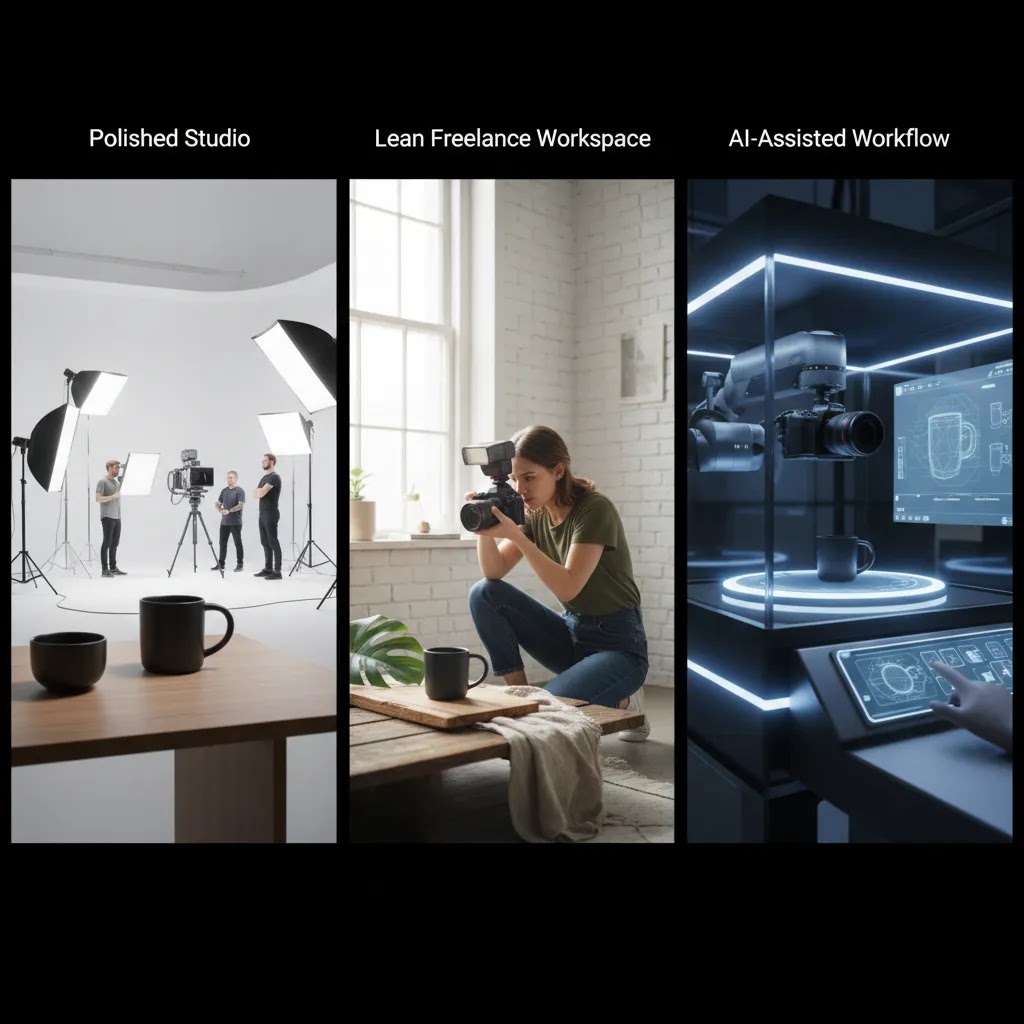
If you are researching product photography pricing nyc, you are usually evaluating three routes: a traditional NYC studio, an independent photographer, or an AI-assisted production workflow. Each comes with different tradeoffs in cost, control, and speed.
Traditional studios are often the strongest choice for brands that need polished campaign assets, on-model lifestyle scenes, or complex lighting for reflective products. That route can make sense if your products need premium positioning and your margins support custom production. If you are still comparing shoot formats, it helps to review the broader product photography fundamentals before committing.
Freelancers may lower costs, but pricing can still rise quickly once you add prop sourcing, retouching, and commercial usage rights. AI tools are becoming a practical alternative for stores that need a faster, more repeatable workflow for PDP images, marketplace listings, and creative testing.
Current tool data available to AcquireConvert includes AI image solutions such as AI Background Generator, Free White Background Generator, Increase Image Resolution, Remove Text From Images, Background Swap Editor, Place in Hands, Magic Photo Editor, and Creator Studio. Pricing details were not returned in the product feed, so this article focuses on NYC market pricing patterns and where these tools may help reduce production costs rather than quoting unsupported figures.
NYC Studio Logistics and Shoot Models
Here's the thing, NYC pricing is often influenced by operational details that never show up in a portfolio. Before you compare quotes, it helps to understand the two common ways studios run ecommerce product shoots, and how that affects cost, control, and turnaround.
Drop-off shoots vs attended shoots
Drop-off (or ship-in) product shoots are common for high-volume catalog work. You deliver samples to the studio, they shoot to your shot list, then send selects and finals back digitally. This model can be efficient if you have a tight, repeatable standard for angles, crops, and retouching. It may also reduce time spent on set, which is one reason some studios can keep per-SKU costs lower.
Attended shoots are where you or someone from your team is present for part or all of the shoot. In NYC, that can mean an in-studio session with live review on a monitor, or remote attendance where you approve frames as they come in. You typically pay more for this because it uses more studio time and coordination, but you may reduce rework if your products are hard to style, the color needs to match tightly, or your brand has specific merchandising rules.
From a practical standpoint, drop-off shoots work best when your brief is crystal clear. Attended shoots can make sense when you are building a new visual standard, launching a hero product, or dealing with products that are easy to misrepresent on camera.
The workflow most NYC studios use (brief to delivery)
Regardless of who you hire, a smooth project usually follows a predictable sequence. If a provider cannot clearly explain their process, that is often where delays and surprise charges creep in.
In many cases, you should expect:
- Brief and shot list: you define angles, crops, background, styling references, and deliverables per SKU.
- Product intake: you drop off or ship samples, the studio checks quantities and condition, then confirms what they received.
- Prep and styling: steaming, lint removal, assembly, prop placement, label orientation, and variant organization.
- Shooting: capture for packshots, details, and any lifestyle scenes you specified.
- Selects: you review proofs or contact sheets, then confirm which frames move to retouching.
- Retouching: cleanup, color correction, background work, compositing if needed, and file formatting for Shopify or marketplaces.
- Approvals and revisions: you request changes, and the studio confirms whether those are included or billed as additional work.
- Final delivery: exports in the agreed formats and naming convention, often including crops for PDP and ads if scoped.
Questions to ask upfront to reduce surprises
What many store owners overlook is that NYC studios often run like production shops. Policies matter. Before you commit, ask about operational details that directly affect budget and risk.
- Drop-off and pickup hours: are they strict, and do they charge for after-hours handling?
- Sample handling policy: how do they label, store, and track variants, and what happens if packaging is damaged in transit?
- Minimums: minimum number of SKUs, minimum spend, or minimum retouched images.
- Turnaround definitions: does turnaround start at intake, shoot day, or after selects are approved?
- Reshoot policy: what counts as a studio error versus a brand change in direction, and how is each billed?
- Revision billing: are revisions included per image, per round, or billed hourly after a threshold?
If you are selling on Shopify, also ask whether they deliver files already optimized for web use (dimensions, aspect ratio, and consistent background), or whether you should plan for internal post-processing before upload.
Pricing and Costs
NYC photography pricing usually falls into a few common structures: per image, per product, half-day or full-day studio rates, and custom commercial estimates. Basic ecommerce packshots with simple white-background delivery may come in at the lower end of the range, while styled shoots, model photography, ghost mannequin, video, or 360 product photography pricing can push quotes much higher.
For ecommerce operators, the real cost is rarely the base shoot fee alone. You may also pay for shot planning, prep, sample handling, steaming, styling, retouching, color correction, revisions, set construction, location fees, talent, and rush turnaround. Commercial product photography pricing in NYC often reflects usage too. Images intended for a Shopify product page may be priced differently from assets used in paid ads, Amazon listings, print, or OOH campaigns.
If you run a lean brand, ask for a line-item estimate. That makes it easier to compare a studio quote against a hybrid setup using AI tools for repetitive work such as background changes, cleanup, or resolution enhancement. For some stores, a lower-cost studio shoot paired with post-production tools like Free White Background Generator or Increase Image Resolution could reduce total spend while still producing usable product-page assets.
For stores building a repeatable visual system, it is also worth reviewing the wider Product Photography Fundamentals category and related Catalog Photography resources before signing a long-term studio agreement.
How Photography Pricing Is Built (And Why NYC Quotes Vary)
Consider this, a quote is rarely “just” a per-image price. Photographers and studios build rates from time, labor, and risk. When you understand the underlying logic, you can spot estimates that are unrealistic in either direction, and you can scope the work so you are paying for what matters.
What typically drives the number on the estimate
Most NYC quotes are built from some combination of:
- Time per SKU: products that need prep, assembly, or careful styling take longer, which pushes cost up even if the final deliverables are similar.
- Retouching time: clean white backgrounds, dust cleanup, label straightening, and color matching can be fast or slow depending on how consistent the capture is.
- Overhead: studios carry rent, equipment, assistants, and production management. Freelancers may have less overhead, but they may outsource retouching or styling.
- Production complexity: model, hair and makeup, set styling, props, special surfaces, or difficult materials (glass, chrome, glossy packaging) all add steps.
- Usage scope: broader licensing can raise the total fee, even if the photos look simple.
This is why two “per image” quotes can be wildly different. One may assume minimal retouching and tight usage. Another may include heavier post work, managed workflow, and broader rights.
What “per image” often includes, and what it may exclude
The phrase “per image” is where a lot of confusion starts. In many cases, per-image pricing includes capture and basic editing for the selected finals. It may not include the work that takes time before and after the shutter click.
When you read an estimate, look for whether it includes or excludes:
- Prep: steaming, lint removal, shaping, assembling products, unboxing and reboxing, and variant organization.
- Basic vs advanced retouching: simple cleanup and color correction versus composite work, label replacement, or heavy texture correction.
- Clipping paths and background accuracy: true white background with clean edges can be fast for some products and tedious for others.
- Color matching: matching products to physical samples, or matching across a catalog so variants look consistent on Shopify.
- File formatting and exports: crops, aspect ratios, and naming conventions that align with your Shopify workflow.
The reality is, line-iteming helps you compare quotes fairly. A low per-image number can be a great deal, or it can mean that all the work you actually need is sitting in “additional retouching” and “additional rounds.”
A simple quote sanity check for Shopify brands
Think of it this way, if you cannot compare two quotes side by side, you are not really comparing price. You are comparing assumptions.
Before you approve a vendor, make sure the estimate clearly spells out:
- How many SKUs and how many finals per SKU, including angles and crops.
- What counts as a final image, and whether proofs or selects are provided.
- Retouching scope, and what is considered “basic” versus “extra.”
- Number of revision rounds, and how overages are billed.
- Turnaround time, and what triggers rush fees.
- Usage terms, even if it is just “web use for your brand website and Shopify store.”
- Deliverables, including file type and any cropping or background requirements.
If you are negotiating, the cleanest lever is usually scope, not haggling the rate. Reduce angles, reduce styling, or separate hero images from bulk catalog. You typically end up with a better outcome than squeezing a provider into a price point that forces shortcuts.
Trust and Credibility
When evaluating a product photography studio nyc provider, trust matters as much as pricing. A low quote is not helpful if the provider misses color accuracy, cannot follow shot lists, or delivers files that need heavy rework before uploading to Shopify.
Start with evidence that the provider understands ecommerce image standards, not just editorial photography. Ask for examples of clean packshots, variant consistency, close-up detail images, and marketplace-ready white background work. If Amazon is part of your channel mix, amazon product photography pricing should be discussed separately because compliance and formatting requirements can affect scope.
At AcquireConvert, we assess photography and AI image workflows from the perspective of what actually supports online selling. Giles Thomas’s experience as a Shopify Partner and Google Expert is useful here because image quality influences both conversion rate optimization and paid acquisition efficiency. Better creative can improve click-through and shopper confidence, but results will always vary by product type, traffic source, and execution.
For AI tools, trust signals are different. You are looking for controllable outputs, consistent editing, and realistic results that do not misrepresent the product. Tools such as Creator Studio and Magic Photo Editor may fit brands that want faster iteration without a full studio booking for every update.
Usage Rights and Licensing: A Practical Guide for Shopify Brands
Now, when it comes to NYC commercial photography, “usage” is one of the biggest sources of misunderstanding. Many brands assume the shoot fee automatically includes unlimited rights, forever. Sometimes it does. Often it does not, especially as the scope moves beyond basic ecommerce packshots.
What “usage” commonly means in NYC product photography
Usage is how, where, and for how long you can use the images. The broader the usage, the more value the images can create for your business, and the more a provider may charge for that license.
In practice, you will often see usage broken out as:
- Owned web: your Shopify product pages, collection pages, and your brand site.
- Email and organic social: newsletters and non-paid posts.
- Paid advertising: Meta ads, Google Ads, marketplaces, and other paid placements.
- Print: packaging, catalogs, retail displays, or press.
- OOH: billboards, subway, and other out-of-home placements.
If your images are only intended for Shopify PDP use and maybe email, be clear about that. If you plan to use them in paid ads, say that too. Paid usage is common for ecommerce brands, but it can change the licensing terms and the fee structure.
What to specify so you do not overpay
From a practical standpoint, you want licensing terms that fit what you will actually do over the next year or two, not a vague “maybe someday” plan that makes the quote more expensive.
When you request a quote, specify:
- Channels: Shopify PDP, email, organic social, paid social, Google Ads, marketplaces, print.
- Duration: 3 months, 12 months, 24 months, or in perpetuity, depending on your product lifecycle.
- Geography: US only versus worldwide.
- Exclusivity: most Shopify brands do not need exclusivity, but if you do, it can increase fees.
- Raw files: many studios do not deliver raw files by default. If you want raws for internal editing, clarify whether that is possible and how it is priced.
If you are building a hybrid workflow, it is also worth confirming whether your license allows you to create cropped versions and common ecommerce adaptations. Most providers allow basic resizing and cropping, but policies can vary, so it is better to confirm than assume.
Common licensing pitfalls to avoid
What many store owners overlook is that licensing can collide with other elements of production, especially on lifestyle shoots.
- Assuming unlimited usage: if your quote does not state usage, ask. Silence can lead to disagreements later, especially once you start running paid ads.
- Mismatched deliverables: you might be licensed for paid ads, but only receive a handful of finals that are not cropped or framed for ad placements.
- Model and influencer releases: on-model product photography can require releases that specify usage, duration, and channels. If the release is limited, your brand usage may be limited too, even if you own the product images.
If you are unsure, ask the provider to write usage in plain language. You do not need legal jargon. You need to know where the images can appear, and for how long, so your Shopify merchandising and acquisition plans are not blocked later.
Key Features That Affect Pricing
The biggest pricing driver is the kind of output you need. A straightforward single-angle product shot costs less than a styled set with multiple props, compositing, and advanced retouching. Before requesting quotes, define the exact deliverables for each SKU.
Shot complexity is first. Reflective, transparent, metallic, or textured products typically require more lighting control and retouching than flat textiles or boxed goods. If you are still choosing equipment for internal production, this guide to the best camera for product photography can help you decide whether bringing some work in-house is realistic.
Volume is next. Pricing for product photography usually drops per item as volume increases, but only if the shot setup stays consistent. This matters for brands with 11 to 50 products, where a standardized catalog approach can create meaningful savings.
Creative format also changes the quote. Flat lays, model photography, 3d product photography nyc services, stop motion, and 360 product photography pricing all require different workflows. If your products sell better with top-down styling, reviewing these flat lay photography ideas may help you build a more precise brief and avoid overpaying for unclear direction.
Post-production scope is another major variable. AI-assisted editing can sometimes replace manual background cleanup or speed up version creation. Tools like AI Background Generator, Background Swap Editor, and Remove Text From Images may be useful if you want to repurpose existing photos for seasonal campaigns, paid social, or new Shopify collection pages.
Use case by sales channel matters too. Product page images, Amazon main images, paid ad creatives, and wholesale line sheets do not always require the same production value. Your ideal spend depends on where the asset will be used and whether the image is intended to convert a warm visitor or stop a cold-scrolling shopper.
If you are comparing outside vendors, this overview of what to expect from a product photography studio can help you evaluate whether you need a specialist studio, a freelancer, or a lighter AI-supported workflow.
Pros and Cons
Strengths
- NYC offers a wide range of specialist studios, freelancers, stylists, and retouchers, so brands can usually find a service level that matches their catalog and positioning.
- Higher-end NYC providers are often well suited for premium DTC brands that need campaign-quality visuals in addition to standard ecommerce shots.
- There is strong flexibility in production format, including white-background packshots, lifestyle scenes, flat lays, model imagery, 360 spins, and some 3D workflows.
- AI editing tools can reduce manual post-production for repetitive catalog work, especially for background swaps, cleanup, and image enhancement.
- Brands selling on Shopify, Amazon, and paid social can often build one shoot plan that supports multiple channels if the brief is clear from the start.
Considerations
- NYC pricing is often higher than national averages because studio overhead, crew costs, and turnaround expectations are higher.
- Quotes can look reasonable at first, then increase once retouching, usage rights, revisions, and styling are added.
- AI tools may save time and cost, but they are not ideal for every product type, especially where exact texture, fit, or color fidelity is critical.
- Lower-cost providers may not understand ecommerce file requirements or channel-specific needs, which can create rework later.
- Premium creative photography is not always necessary for every SKU, so some brands end up overproducing assets that do not materially improve sales.

Who It's Best For
This pricing approach is most relevant for ecommerce brands actively choosing between an NYC studio and a more scalable alternative. If you run a Shopify store with a premium product line, seasonal launches, and enough margin to support creative production, a studio-first route may be justified. If you have a large catalog, frequent SKU refreshes, or tighter contribution margins, a hybrid workflow is often more sensible.
That hybrid route could mean booking one foundational shoot for hero images, then using AI tools such as Place in Hands for creative variations or AI Background Generator for alternate scene generation. Smaller brands should usually be cautious about paying NYC campaign rates unless they know exactly how the assets will support conversion and acquisition.
How to Get Started
First, define the image types you actually need. Separate your must-have PDP shots from nice-to-have campaign assets. That alone can tighten your quote and prevent overspending.
Second, group products by complexity. Apparel, beauty, jewelry, food, and reflective packaging all require different treatment. Send examples and specify dimensions, background requirements, and output formats.
Third, ask every provider for the same pricing framework: per image, per product, retouching cost, turnaround, revision policy, and usage terms. Comparable quotes are much easier to evaluate than custom proposals with vague scope.
Fourth, test before committing. Start with a small batch of products and upload the resulting assets to your store. Watch how the images perform across PDPs, ads, and marketplaces. If the quality is close but not perfect, consider whether tools like Increase Image Resolution or Remove Text From Images can extend the value of that first shoot.
Fifth, document your visual standard. Once you know what works, create a repeatable shot list and editing brief. That gives you a more scalable process whether you continue with an NYC studio or move parts of production in-house.
Frequently Asked Questions
How much does product photography usually cost in NYC?
There is no single market rate because pricing depends on image type, number of SKUs, styling, retouching, and commercial usage. Basic ecommerce packshots often cost less than custom lifestyle or ad creative shoots. Always ask for a line-item quote so you can see what is included and avoid comparing incomplete estimates.
Is NYC product photography worth it for a Shopify store?
It can be, especially for brands where product presentation strongly affects trust and average order value. Premium skincare, jewelry, fashion, and gift products often benefit more than commodity items. The key is matching production value to margin and channel strategy, rather than assuming a higher-priced studio will automatically improve conversion.
What increases commercial product photography pricing the most?
Creative direction, set styling, retouching, talent, location work, and broader licensing terms usually have the biggest impact on cost. Complexity also matters. Reflective or transparent products often need more technical lighting and editing. If your images are only for PDP use, say so, because wider usage can increase the quote.
Should I choose a studio or use AI tools instead?
A studio is usually better for original hero photography, high-end branding, and products that need precise realism. AI tools may work well for background changes, catalog updates, and creative testing. Many ecommerce brands now use both, which can lower ongoing costs without fully replacing professional capture.
Do I need separate pricing for Amazon product photography?
Often, yes. Amazon images can have stricter formatting and compliance expectations than Shopify PDP images. If your provider understands marketplace requirements, they can structure the shoot correctly from the start. That may help avoid reshoots or editing rework later, which is where hidden cost tends to show up.
Does 360 product photography pricing make sense for every store?
No. 360 spins can help with products where detail and dimensionality matter, such as footwear, tech accessories, or premium packaging. They are less valuable if shoppers can already understand the product from a few strong still images. For many stores, better still photography offers a stronger return than adding motion assets immediately.
Can AI editing tools replace a product photography studio NYC brands use?
Not fully in most cases. AI is strongest as a support layer for editing, variation creation, and speed. It may not be the best choice where exact product accuracy is critical or where a brand needs original campaign imagery with full creative control. Think of it as a cost-management tool, not a universal replacement.
How much do I charge for product photography?
If you are a photographer pricing product work, you will typically base your rate on time (shooting plus retouching), production overhead, and usage. From a brand perspective, this is useful because it explains why quotes vary. A “per image” price can be built on a fast catalog workflow with light editing, or it can include heavier prep, advanced retouching, and broader licensing. If you are hiring in NYC, ask the provider to break out shoot time, retouching assumptions, and usage terms so you can compare apples to apples.
What is the 20 60 20 rule in photography?
People use “20 60 20” in a few different ways, but in commercial product photography it is often shorthand for where time goes: a smaller portion on capture, the biggest portion on prep and post-production, and another portion on admin and coordination. For Shopify brands, the takeaway is simple. The image you receive is the end of a longer workflow, so a quote that ignores prep, styling, or retouching usually means those costs will show up later as add-ons, delays, or inconsistent results.
How much should I charge for a product shoot?
For photographers, a common approach is to price based on the production unit that matches the job: per SKU for repeatable catalog work, per image for defined deliverables, or half-day and full-day rates for complex setups. For store owners reviewing NYC quotes, ask which unit the provider is using and why. A day rate can be fair when products vary and setup changes often. Per-SKU or per-image can be fair when the shot list is standardized and the retouching scope is clear.
How much do product photographers make in NYC?
It varies widely based on experience, client type, and whether they run a studio with staff or operate independently. Many NYC product photographers price in ways that reflect high overhead, time-intensive retouching, and commercial usage. For brands, the more important point is that sustainable pricing usually correlates with reliable process and consistent output. Extremely low quotes can work for simple jobs, but they can also signal rushed capture, minimal retouching, or unclear licensing.
Key Takeaways
- Product photography pricing in NYC is shaped by scope, not just the shoot day rate.
- The biggest hidden costs are usually retouching, styling, revisions, and usage rights.
- Shopify brands should align image spend with margin, catalog size, and channel mix.
- AI tools may reduce ongoing post-production costs, especially for repetitive ecommerce image tasks.
- Testing a small batch first is usually the safest way to choose between a studio, freelancer, or hybrid workflow.
Conclusion
For most ecommerce brands, product photography pricing nyc makes sense only when the output matches a clear commercial purpose. If you need premium hero imagery, campaign visuals, or technically difficult product shots, a strong NYC studio can be worth the higher cost. If your priority is scalable catalog production, faster launches, and tighter margin control, a hybrid workflow may be the smarter move. That could mean using professional capture for key images, then extending those assets with AI-based editing and scene variation tools. AcquireConvert evaluates these choices through a practical ecommerce lens, with Giles Thomas’s Shopify Partner and Google Expert experience helping store owners focus on what may actually improve product presentation and shopper confidence. Your next step is simple: request itemized quotes, test a small batch, and compare the output against your store’s real merchandising needs.
Disclosure: AcquireConvert may receive affiliate compensation from some third-party links referenced in this article. We only include tools and resources that are relevant to ecommerce operators. Pricing details for the AI products listed were not provided in the available product data, so no unsupported price claims have been made. Any performance impact from improved photography or AI editing will vary based on your store, product category, traffic quality, merchandising, and implementation.
Hi, I'm Giles Thomas.
Founder of AcquireConvert, the place where ecommerce entrepreneurs & marketers go to learn growth. I'm also the founder of Shopify agency Whole Design Studios.